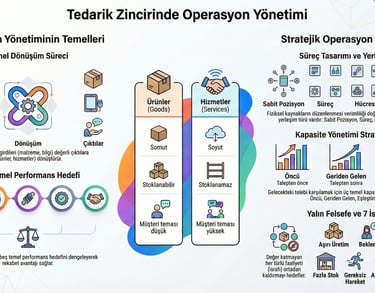
Operations Management
Learning Outcomes – Operations Management Training
Participants who complete this training will be able to:
1. Position Operations Management as a Strategic Function
Understand that operations management is not just about cost control, but a field that creates sustainable competitive advantage.
Link operational decisions to company strategy, customer satisfaction, and profitability.
2. Analyze Operational Systems End-to-End
Evaluate components such as facility layout, capacity, inventory, quality, and project management as a complete system.
Analyze how local improvements affect overall system performance.
3. Interpret Demand Accurately and Plan Resources Efficiently
Distinguish between dependent and independent demand.
Select appropriate quantitative and qualitative demand forecasting methods.
Explain how capacity planning, scheduling, and sequencing decisions impact operational performance.
4. Manage Inventory as a Financial and Operational Tool
Understand why inventory serves as a “safety blanket” and which risks it hides.
Apply ABC analysis, EOQ, and periodic/fixed order systems effectively.
Balance inventory levels with service level requirements.
5. Apply Lean Thinking on the Shop Floor
Identify the seven wastes using real operational examples.
Translate concepts like JIT, Kanban, takt time, SMED, and jidoka from theory to practice.
Embrace continuous improvement (Kaizen) as a daily work habit.
6. Manage Quality as a System, Not Just Inspection
Evaluate the eight dimensions of quality from the customer’s perspective.
Break down quality costs and explain why prevention is the most cost-effective approach.
Know which tools—SPC, FMEA, TPM—are appropriate for specific problems.
7. Manage Projects in a Disciplined and Predictable Way
Clearly distinguish between project work and daily operations.
Use WBS, Gantt, CPA, and PERT for project planning and control.
Apply critical path and slack concepts to prioritize resources.
8. View the Supply Chain as a Network
Analyze the operational network including upstream and downstream flows.
Select appropriate network and sourcing strategies based on product type (functional vs. innovative).
Evaluate make-or-buy and integration decisions through a core competency lens.
9. Develop Data-Driven and Systematic Decision-Making Skills
Make structured and analytical decisions rather than intuitive ones.
Identify the right indicators to measure operational performance.
Balance short-term gains with long-term sustainability.
10. Translate Operations Language into Executive Language
Frame shop floor problems as strategic risks or opportunities.
Connect operational improvements to financial outcomes.
Present value-focused, persuasive insights to senior management.