
Automotive Semi-conductor Crisis
The automotive chip crisis was much more than just an industry headline for me. It exposed, in stark terms, the true role of procurement within a company.
1/8/20222 min read

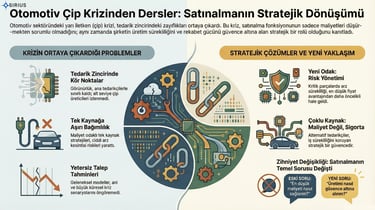
The automotive chip crisis was much more than an industry headline for me. It exposed the true role of procurement within the company in a very clear way. Procurement, long seen as a “cost-cutting” and “contract-renewal” function, suddenly became strategic when production lines ground to a halt over a chip no bigger than a few millimeters.
When the pandemic began, like many automakers, we lowered our demand forecasts. We cut orders, thinking we were being flexible. At the same time, demand in consumer electronics surged. No one could fully predict how those early decisions would corner us months later. Chip makers diverted capacity to other sectors, and automotive ended up at the very end of the line.
That’s when we realized the real problem wasn’t the cost of the chip. The problem was simply not being able to get it.
Producing a car means managing millions of parts. Yet sometimes production is stopped by a component that costs just a few dollars. Sitting at the procurement table, the situation was clear: contracts existed, but the material didn’t. Approved suppliers were in place, but capacity wasn’t. Alternatives existed, but processes didn’t allow for them.
This crisis taught me just how vital supply chain visibility is. We knew our Tier-1 supplier, but we didn’t know their supplier. Where was the chip made, in which factory, at what capacity, these details weren’t part of our procurement decisions. Yet in a crisis, that information became as important as the price.
Another harsh lesson was about single-source strategies. Approaches we defended for years because of cost advantages left us vulnerable in a crisis. Setting up alternative suppliers now took months instead of weeks. A clear awareness emerged: multiple sources for critical components are not a luxury, they are a risk management tool.
On the demand forecasting side, there was a similar awakening. Excel sheets, historical data, and linear projections weren’t enough to explain the crisis. Procurement had to ask not only “how much will we buy?” but also “what happens if we can’t?” Scenario planning, safety stocks, and contractual capacity commitments moved to the center of our agenda.
Perhaps the biggest change was in how procurement was perceived. Companies that came out ahead during the crisis weren’t those who pushed the hardest on price, but those who built long-term relationships with suppliers. Firms that got involved early in capacity planning, shared risk, and saw suppliers as more than just price quotes were able to get production moving faster. Procurement acted not just as an operational function, but as a strategic one.
Looking back now, I see the chip crisis not as a disaster, but as a warning. As electric vehicles, batteries, software licenses, and rare materials become more central, similar crises will arise again. The question isn’t “Will a crisis happen?” The question is “How ready are we as procurement?”
I’ve learned this clearly: procurement isn’t just a cost-managing function. When done right, it protects production, keeps the company running, and creates real competitive advantage.